Wednesday, May 21, 2014

Cooking Through "The Baker's Man": Rainbow Truffles


Randy Pausch, writer of The Last Lecture, said, “Never lose the childlike wonder. It’s just too important. It’s what drives us.” Try and remember what it was like when you saw the world through childlike eyes full of awe, when so much of what you saw was so marvelous it stole your breath, left you speechless.


Walt Disney said, “Too many people grow up. That’s the real trouble with the world, too many people grow up. They forget. They don’t remember what it’s like to be twelve years old.” It’s easy to become caught up in everyday life—rush hour traffic, bills, crazy work environments, making dinner, working out, cleaning house… Becoming an adult isn’t always as awesome as it seemed like it would be when we were young. But it doesn’t have to be routine, boring, or dull.

Thursday, May 15, 2014

Cooking Through "The Baker's Man": Mexican Chocolate Truffles


Eating healthier foods can give us all sorts of benefits, such as stronger bones, bodies, and minds. Eating avocados gives you shinier hair and smoother skin. Eating strawberries boosts short term memory and burns fat. Eating dark chocolate lowers your blood pressure. I would like to add that eating chocolate makes me happier.

Healthy foods make us, well, healthier, but there are other benefits of food. When people visit Bea’s Bakery in The Baker’s Man, they can find just the treat that they need. Need the courage to ask your crush to go on a date with you? No problem. Need help deciding which college to attend? She has the answer for you.

Monday, May 12, 2014

Cooking Through Fiction: Smoked Salmon and Bacon Paté


Have you ever noticed that when people travel through time or space, they don’t seem to be preoccupied with food or travel snacks? I would not be this person. I need to know there will be snacks because I know that I will get hungry—I don’t care how awesome time traveling might be.


In Madeleine L’Engle’s novel A Wrinkle in Time, Meg, Calvin, and Charles Wallace journey through the universe by means of tesseract. What is a tesseract? In geometry, the tesseract is defined as a 4-dimensional analog of a cube. Say what?!

Let’s try to simplify this concept. Draw a straight line. That’s a 1-dimensional object. Draw a square. It has height and width; that’s a 2-dimensional object. Draw a cube. Now the object has height, width, and depth. It’s 3-D! So…4-D adds a fourth element to the mix. Time! It's a cube within a cube.

Wednesday, May 7, 2014

Cooking Through Fiction: Cinnamon-Sugar Candied Pecans


One thing I love to see while traveling down back roads on my way to somewhere new is a hand-painted, side-of-the-road sign advertising some tasty treat around the next bend. Boiled peanuts! Peaches! Honey! (Okay, these signs are all in Georgia because so is Lost Lake!) But who doesn’t love those signs? Who isn’t tempted to stop?

While driving toward Lost Lake, Kate and her daughter pass an army of hand-painted roadside signs that promise fresh fruits and candied nuts. They’ve been salivating for miles, waiting to see these homemade treats. Finally, just as promised, the stand appears. I’m pretty sure Kate and her daughter finished the bag of cinnamon pecans before they could climb back into the car. They’re that good. Trust me. Like potato chips—you can’t have just one. Or two. Or one handful. Or two handfuls. Poof! They’re gone.

Monday, May 5, 2014

Cooking Through Fiction: Lost Lake's Ham-and-Cheese Puff Pastry


Thomas Wolfe wrote a novel titled You Can’t Go Home Again in which the main character realizes that although he can literally go home again, his home will not be as he remembers. The phrase “you can’t go home again” has come to represent the idea that once you leave home for bigger and brighter places, every attempt you have to relive youthful memories will fail. Is this true? I say, “Not really. Not for me.” And not for Kate and a slew of others in Addison Allen’s Lost Lake.

In fact, many characters in Lost Lake return to their summer retreat every year for the very reason that they can relive the memories and hang on to what has become so special to them. Kate returns to Lost Lake with her daughter in search of something she lost years ago, and they find more than they expect, including happiness, love, and home.

Wednesday, April 30, 2014

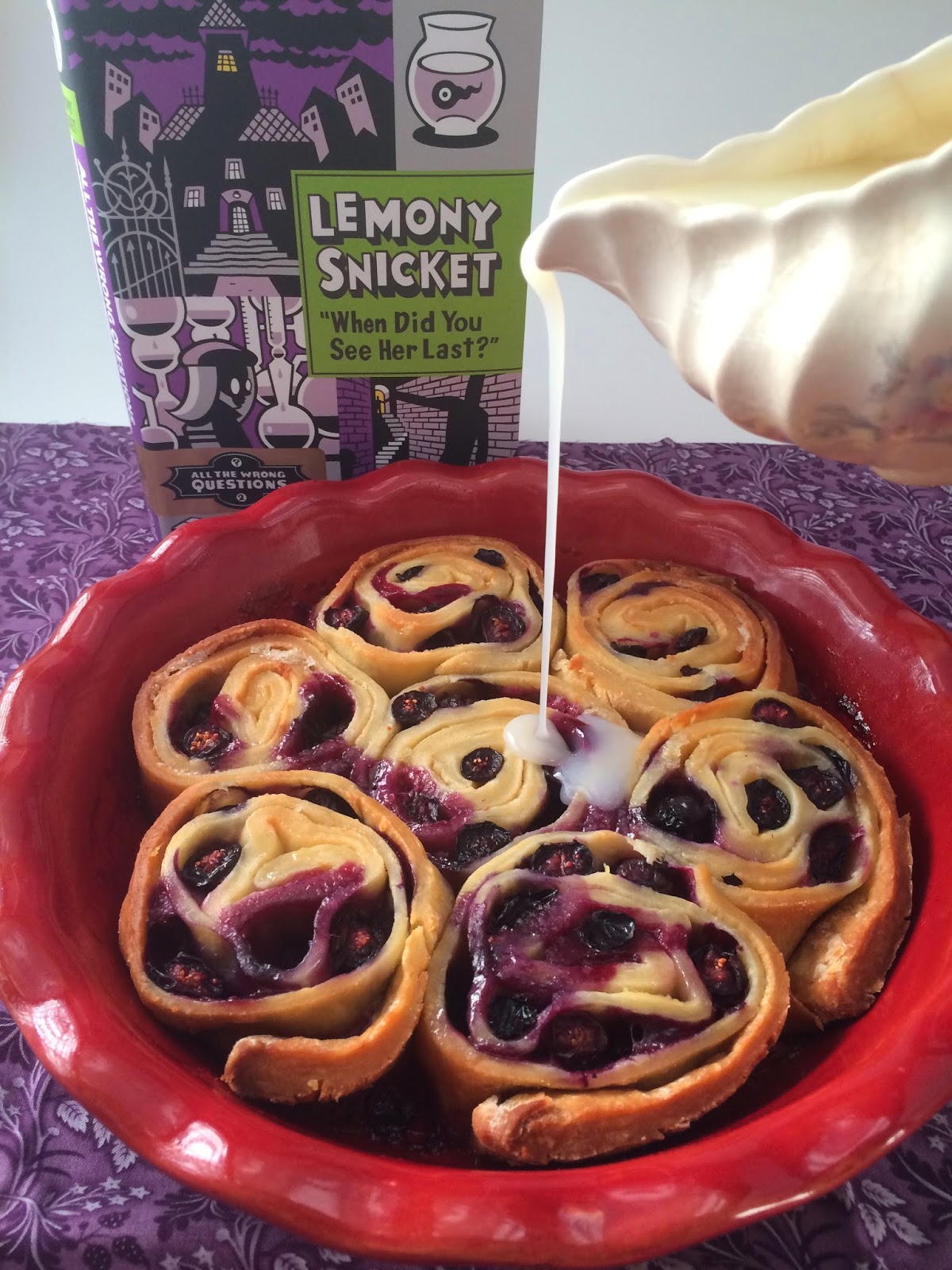
Cooking Through Fiction: Snicket’s Lemony Blueberry Sweet Rolls


What makes a great friend? Someone who is there for you when you need a person to listen to you ask thousands of questions during TV shows (I’m not saying this is me, but this is me.)? Someone who brings you chicken noodle soup when you’re sick? Or someone who doesn’t laugh when you trip over your own feet (Does this person exist?)?


In Snicket’s second novel in the series All the Wrong Questions, Snicket would likely say a friend does these two things: 1) looks for you when you are missing, and 2) gives you a cinnamon roll fresh from the oven. I have to say, these are two fantastic qualities in a friend.

Sunday, April 27, 2014

Cooking Through Fiction: Extraordinary Apple Pop Tarts


Extraordinary — (adjective) beyond what is ordinary or usual; highly exceptional, remarkable

I am a lover of words (a logophile). I can admit to being so nerdy that I am saddened when a word (especially hundreds of words in a language) dies. The Oxford English Dictionary labels these words obsolete. I bet thousands of words are thinking, Man, I hope I don’t become obsolete—oh, no, there goes hugger-mugger! Hugger-mugger was a real, useable word once. Feel free to bring it back. It means “to act in a secretive manner.” Sometimes I hugger-mugger in the middle of the night and eat peanut butter.


Other problems that happen to words is that they become “watered down.” Did you know that awful used to denote “inspiring awe or fear”? Now, if something is awful, it’s usually crapola (a made-up word). For example, once upon a time you could have described a cathedral as awful, but now if you said that, people would call you rude.